The Chimney Isn't Leaking — Your Roof Is
A homeowner notices a brown ring spreading across the ceiling a few feet from the fireplace. They call a mason. The mason repoints some mortar, tucks in a bead of caulk where the brick meets the shingles, and writes an invoice for $2,400. The next heavy rain, the ring gets bigger. The mason comes back, shrugs, and says the roof is the problem after all.
That sequence plays out in thousands of American homes every year, and it usually runs in the wrong direction. The masonry almost never fails first. The roof-to-chimney transition does.
Why the Brick Gets the Blame
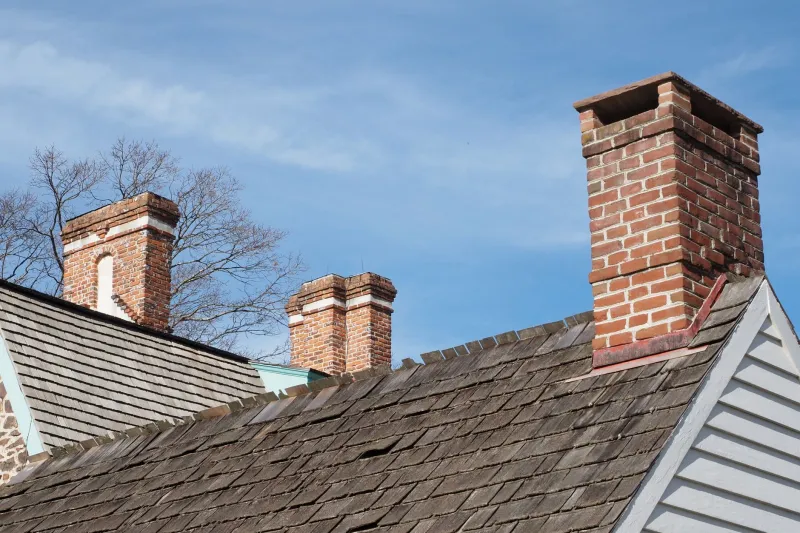
Brick is honest about its problems. It spalls, it grows white efflorescence, it soaks up water like a sponge. When you stand in the yard and look up, the chimney is the most visually complicated thing on the roof — a tall, porous tower wrapped in mortar joints. It looks guilty.
But water is lazy and opportunistic. It rarely travels down through solid masonry when it can slip in at a seam, ride a nail, and drip out eight feet away. Most chimney leaks begin at the point where the roof plane meets the chimney wall, and that junction isn't masonry work. It's roofing work.
The Joint That Actually Keeps You Dry
A properly built chimney transition has three interlocking parts, and skipping any one of them is how leaks get designed in.
Base flashing. This is the L-shaped metal that runs along the chimney's base and laps over the shingles below it. It should be a durable metal — copper, lead-coated copper, or a heavy-gauge painted steel — not a strip of aluminum coil stock bent on the tailgate. Base flashing should tuck under the shingles on the uphill side and lap over them on the downhill side.
Counter-flashing. This is the piece most often botched. Counter-flashing is the metal that overlaps the top edge of the base flashing and is embedded into a reglet — a cut groove — in the masonry itself, then sealed. It should sit roughly an inch deep in that groove. If you see counter-flashing screwed flat onto the face of the brick with a bead of caulk over the top edge, you are looking at a repair that has already failed; the caulk just hasn't told you yet.
The cricket. On the uphill side of a chimney wider than 30 inches, the International Residential Code requires a cricket — a small peaked roof that diverts water around the chimney instead of letting it pool against the wall. Some jurisdictions require them on narrower chimneys too, and honestly, they should. A cricket is not decorative. It's the difference between water shedding around the chimney and water sitting there, probing the flashing, waiting.
Sealant Is Not a Flashing Strategy
Every roofer has a photo of a chimney transition held together by three tubes of polyurethane. It looks fine for a season or two. Then the caulk shrinks, cracks, and peels, and the leak comes back — usually during a storm that arrives at the worst possible time of year.
Caulk belongs at the end of the job as a secondary defense, not as the primary water barrier. If a bid for a chimney leak consists mainly of sealant and a labor charge, you're buying time, not a repair.
Five Things to Check Before You Call Anyone
You don't need to climb anything to do a useful first pass.
- Look for the cricket. From the ground, a chimney on a sloped roof should have a small triangular or peaked structure on its uphill side. No cricket on a wide chimney is a red flag.
- Eyeball the counter-flashing line. In photos, proper counter-flashing disappears into the brick. Surface-mounted metal with a visible caulk smile is a shortcut.
- Check where the metal meets the shingles. Stepped flashing on the downhill side should look like a staircase, with each piece individually woven into the shingle course — not one long bent panel.
- Look for rust streaks. Rust on the chimney face or shingles below usually means water is sitting where it shouldn't.
- Note whether the stain tracks with wind direction. A leak that only appears in wind-driven rain from one side is telling you about a specific seam, not a general masonry problem.
Who Should Actually Fix It
This is the part that saves homeowners the most money: the roof-to-chimney transition is roofing scope. A chimney sweep cleans and inspects the flue. A mason rebuilds crowns, repoints joints, and replaces spalled brick. Neither trade is set up to remove shingle courses, install cricket framing, weave step flashing, and cut a reglet into masonry.
That means the ideal job is a coordination, not a handoff. The roofer builds the flashing and cricket and leaves a clean reglet. The mason — if crown or brick work is genuinely needed — handles the masonry, and the counter-flashing gets set into the fresh mortar before it cures. When those two trades work in sequence, the repair lasts decades. When they work in isolation, you get a caulk-and-pray cycle that repeats every few years.
At 10 Stars Roofing, chimney transitions are one of the first things we photograph on any inspection, because they're one of the most common causes of the ceiling stains that get blamed on everything else.
What a Real Repair Looks Like
A proper chimney re-flash usually involves removing shingles around the chimney base, inspecting the sheathing and framing for rot, installing or rebuilding the cricket, laying new base flashing with proper laps, cutting a reglet in the masonry, setting counter-flashing, and re-shingling around the assembly. On houses with masonry chimneys, it also means checking the crown and the flue cap, because a cracked crown sends water into the same wall cavity and produces an identical stain.
It's a half-day to a full-day job depending on access and roof pitch. It is not a $150 caulk call, and any contractor who sells it as one is selling you a return visit.
The Bottom Line
When water shows up near a chimney, resist the urge to call the first trade that comes to mind. The brick is probably fine. The joint above it isn't. Get a roofer who can show you photos of the transition, explain where the counter-flashing sits, and confirm whether a cricket is present — then decide what, if anything, the mason needs to do.
A chimney is, functionally, a hole in your roof. Treat the collar around that hole with the same seriousness you'd give any other penetration, and the mystery leak stops being a mystery.