Before Anyone Climbs: The Insurance Check That Protects Your Home and Your Savings
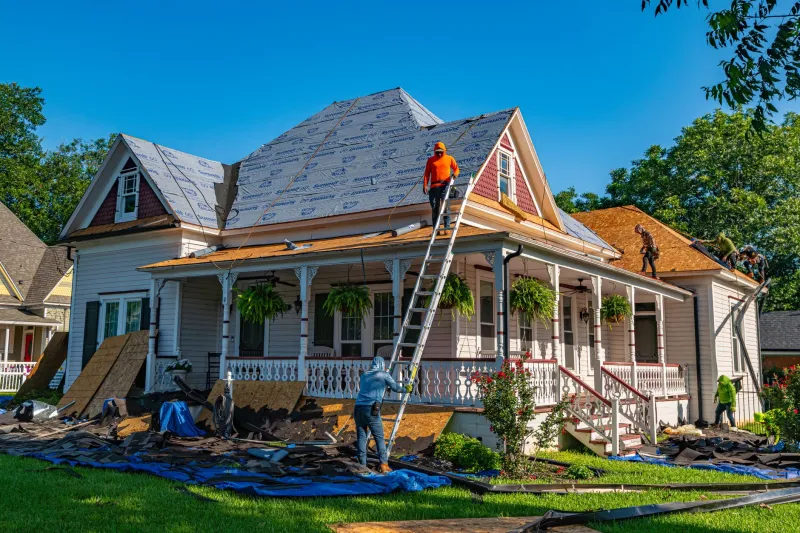
A roofing project starts with a simple image: a ladder against the gutter and someone climbing toward the shingles. What most homeowners do not picture is the paperwork that should happen before that climb. If a crew member falls, a subcontractor gets hurt, or a neighbor's kid wanders onto the job site, the question of who pays can get ugly fast. The answer usually depends on insurance that was verified weeks earlier, not on what anyone assumed at the kitchen table.
The Job Site Is Your Property. That Matters.
When you hire a roofing company, you are not just buying shingles and labor. You are inviting a temporary industrial site onto your home. Nails, tear-off debris, ladders, dumpsters, and power tools all show up together. That is normal for a roof job, but it also means injuries and property damage are possible. In 2026, with material prices and medical costs both stubbornly high, an uninsured injury can turn into a five- or six-figure problem.
Here is the uncomfortable part: the roofer's insurance is supposed to handle the roofer's people. Your homeowners policy is not designed to be the primary safety net for someone else's business. They are two different tools, and mixing them up can leave you holding a bill you never expected.
General Liability and Workers' Comp Are Not the Same Thing
Homeowners often hear the phrase fully insured and assume it covers everything. It does not. Two coverages matter most on a roof job.
General liability insurance covers third-party claims. If a worker drops a bundle of shingles through your neighbor's windshield, or a crew member damages your siding, general liability is the policy that should respond. It can also cover bodily injury to someone who is not an employee of the roofing company, depending on the facts.
Workers' compensation covers the roofing company's employees if they are injured on the job. That includes falls, cuts, heat illness, and worse. In most states, a roofing contractor with employees is required to carry workers' comp. If the company does not have it, an injured worker may look for another source of payment. That search can lead to the homeowner, even when the homeowner did nothing wrong.
A certificate that shows only general liability is not enough. Ask for both. If the roofer uses subcontractors, ask how those subs are covered too. A crew of independent contractors without workers' comp can create the same exposure.
Your Homeowners Policy Is a Backstop, Not a Bodyguard
It is easy to assume your homeowners policy will step in if someone gets hurt on your property. Sometimes it will. But there are limits and exclusions that matter.
Most homeowners policies cover guest injuries and certain liability claims. They are not built to supervise a contractor's business operations. If an injury arises from the roofing company's work, the insurer may argue that the contractor's policy should be primary. If the contractor has no coverage, your insurer might still defend you, but it could also dispute the claim, raise your rates, or pay only up to your policy limits.
There is also the neighbor-kid scenario. If a child wanders onto a job site and gets hurt on a nail or falls from a ladder, the homeowner may face questions about whether the site was reasonably secured. Homeowners policies can respond to certain liability claims, but they are not a substitute for a roofer who keeps a clean, fenced, and supervised site. An umbrella policy can add protection, but it is not a fix for hiring an uninsured contractor.
What a Certificate of Insurance Really Proves
A certificate of insurance, often called a COI, is a one-page snapshot. It shows policy numbers, coverage types, limits, and dates. It is useful, but it is not a guarantee. Certificates can be stale, edited, or issued before a policy is canceled for nonpayment.
Before work begins, verify the coverage directly. Call the insurance agent or the carrier's verification line listed on the certificate. Confirm that the policy is active, that the named insured matches the legal name of the roofing company, and that the dates cover your project. If the roofer cannot provide a clean certificate from an agent or carrier, treat that as a warning sign.
Ask whether your address can be listed as an additional insured on the general liability policy. This is not always required for a residential roof job, but it gives you extra protection if a claim arises from the work. Also ask about completed operations coverage. A roof leak that shows up months after the crew leaves is still a liability question, and the policy needs to be in force when that claim appears.
A Five-Minute Checklist Before the First Nail
You do not need to become an insurance agent. You do need to slow the job down for a few minutes and confirm the basics.
- Get the roofing company's legal name and state license number in writing. Check the license with your state or local contractor board.
- Request a certificate of insurance sent directly from the insurance agent or carrier, not forwarded from a friend or pulled from a website.
- Confirm general liability limits. For most residential roof jobs, $1 million per occurrence and $2 million aggregate is a common baseline. Higher limits are better.
- Confirm workers' compensation coverage with a policy number. If the company claims an exemption, ask for proof and understand what it means in your state.
- Ask whether subcontractors will be on the job. If yes, request their certificates too. Do not accept a promise that they are covered.
- Call the carrier or agent to verify active coverage. Keep a copy of the certificate and your verification notes.
- Read the contract for safety and cleanup language. The roofer should be responsible for securing the site, controlling debris, and following fall-protection rules.
- Do not let the crew start until the paperwork checks out. A five-star roofer will expect this question and answer it without drama.
The Neighbor Kid and the Nail in the Driveway
Liability is not only about falls from the roof. It is also about the job site at ground level. Nails in the grass, unsecured ladders, open dumpsters, and torn-off shingles stacked near a sidewalk all create hazards. Talk with your neighbors before tear-off day. Keep kids and pets away from the work zone. Ask the crew to use magnetic sweeps at the end of each day and to secure the site overnight.
If someone does get hurt, document what happened, take photos, and report it to your homeowners insurer promptly. Do not promise to pay medical bills on the spot, and do not sign anything from the roofing company without reading it. Let the insurers investigate.
What Five-Star Looks Like Off the Roof
At 10 Stars Roofing, we think the five-star label should cover the boring parts too: proof of insurance, a clean job site, a written safety plan, and a crew that knows who is covering what. A roofer who hesitates when you ask for a certificate is telling you something. A roofer who sends it from the agent, verifies the policy, and explains the limits is showing you how the whole job will be run.
Your roof protects your home. The insurance check protects you while the roof is being replaced. Run it before anyone climbs, and keep the paperwork with your project file. In 2026, that clipboard may be the cheapest protection you buy all year.